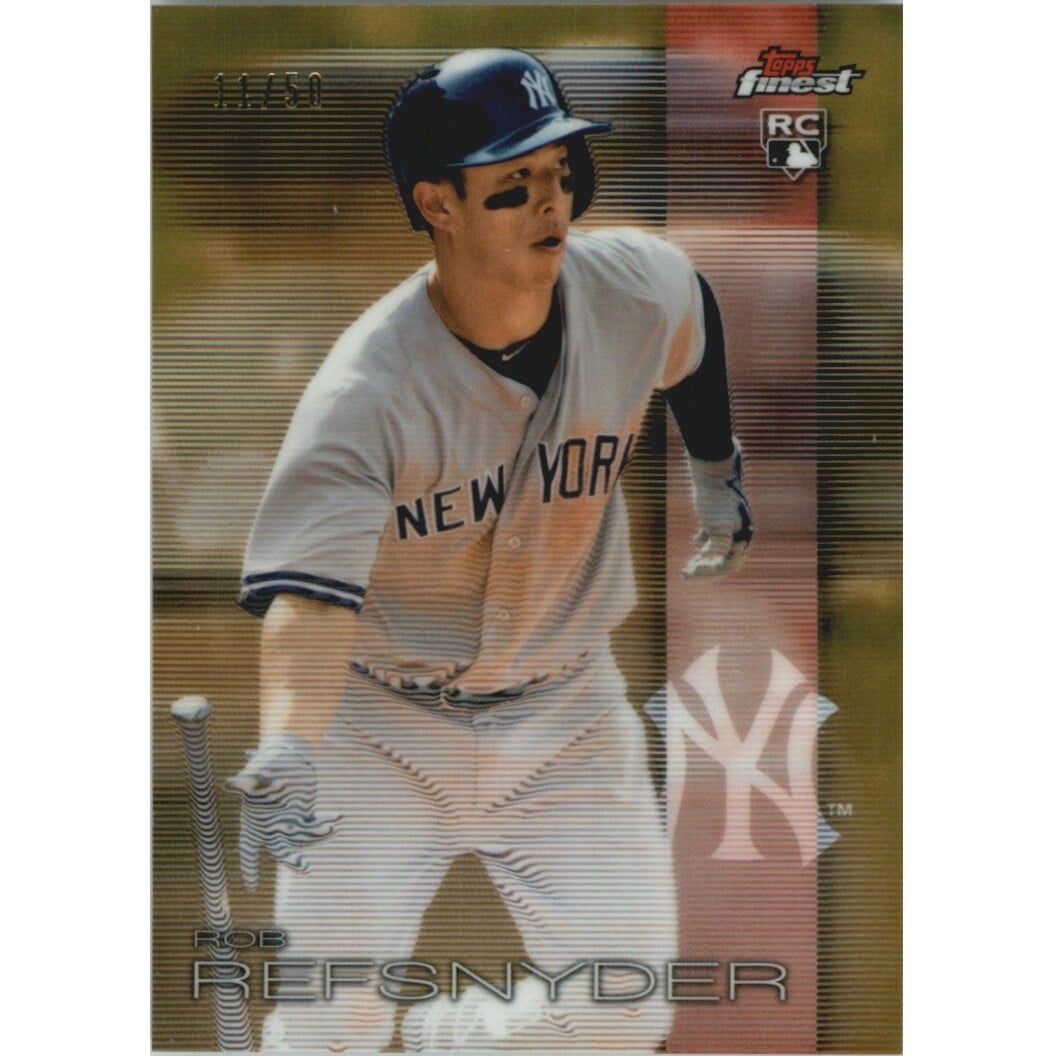
Rob Refsnyder
"A Seoul-born right-handed bat who has built a long big-league career in the margins of the roster, one matchup at a time."
The birth city on his baseball card, Seoul, makes him one of the few MLB players born in South Korea, yet his career followed a very different route from the KBO-trained stars usually associated with the country.
As a right-handed DH on a Mariners roster that has to squeeze value from every platoon matchup, Refsnyder represents the modern, analytics-driven way of building a lineup, where a role player's edge can matter as much as a star's.
Fans tend to read a platoon or bench bat as a lesser player. In practice, a hitter in this role has to be ready on a few days' notice and has to contribute in the specific moments he is picked for. That is a demanding craft of its own, and it is easy to overlook in a box score.
Japanese fans know the idea of the 左殺し (hidari-goroshi), the hitter kept specifically to handle left-handed pitching. American baseball's platoon DH is the same tradition, treated as a legitimate career path instead of a footnote. Refsnyder is a right-handed hitter whose job fits that mold, so his name on a lineup card is a deliberate tactical choice, not a sign of a lesser role.
American fans see 'Seoul, Republic of Korea' on a baseball card and may assume a KBO pedigree. Korea's best-known MLB players, such as Ryu Hyun-jin, Shin-Soo Choo, Kim Ha-seong and Lee Jung-hoo, came up through Korean pro baseball or its amateur system. A Seoul birthplace attached to a player developed in the American college and minor-league pipeline is a different story, and it is one that Korean and American fans may read in very different ways.
Rob Refsnyder was born in Seoul on March 26, 1991, and made his MLB debut on July 11, 2015. He now wears No. 30 for the Seattle Mariners as a right-handed-hitting DH. His career is less a star's arc than a specialist's: a player whose value depends on knowing what he does well and being deployed where it counts. This profile is built only from verified biographical data, so it is shorter than usual.
| Year | Team | G | AVG | HR | RBI | SB | OPS |
|---|---|---|---|---|---|---|---|
| 2026 | SEA | 53 | .140 | 4 | 11 | 0 | .465 |
| 2025 | BOS | 70 | .269 | 9 | 30 | 3 | .838 |
| 2024 | BOS | 93 | .283 | 11 | 40 | 2 | .830 |
| Career | — | 594 | .246 | 37 | 165 | 22 | .710 |
Source: MLB Stats API · regular season
A Career Built on Fit
The verified facts are spare. Refsnyder was born March 26, 1991, in Seoul, stands 5'11" and weighs 215 pounds. He bats and throws right-handed and debuted in the majors on July 11, 2015. A decade-plus later he is still on a big-league roster, which says something by itself. Few players stay in the majors that long without being an everyday star. They do it by making themselves useful in a defined way, and by being valuable to the people who plan matchups.
The Craft of the Specialist
Modern front offices think in terms of platoons, leverage and splits, and a right-handed DH like Refsnyder fits that logic. The work is unglamorous. A player in this role may sit for days, then be asked to deliver in a single plate appearance against a specific kind of pitcher. It takes preparation, patience and a clear understanding of one's own strengths. We do not have interview material for this profile, so we will not claim to know how Refsnyder thinks about it. The shape of his career, though, suggests a player who has made peace with that role and sharpened himself for it.
In American baseball, a platoon pairs two players at one position, usually so that a right-handed hitter faces left-handed pitchers and a left-handed hitter faces right-handed ones. It is a strategic choice, not a demotion, and it is common on teams that rely on data. The closest Japanese parallel is the 左殺し specialist.
Seoul on the Baseball Card
A birthplace is a fact, not a biography, and it would be wrong to read too much into it. Still, the line 'Seoul, Republic of Korea' sits on the record of a player now with the Mariners, and it connects two baseball cultures that are often discussed separately. Korea has a passionate professional league and a long tradition of sending players to the majors. For American readers, the point is that a Korean birthplace does not imply a Korean baseball upbringing. For Korean readers, it is a reminder that the country's presence in MLB has more than one story.
What Comes Next
At 35, Refsnyder is in the stage of a career where each season's role is earned again, and where a team like Seattle, built around pitching and careful roster construction, values exactly the kind of flexibility he offers. His story is not one of stardom. It is a quieter and arguably more instructive one, about how a player can stay in the highest league in the world by knowing precisely what he is for. Whatever the next chapter holds, it is likely to be written in small, well-chosen moments rather than loud ones.
For English-speaking readers: the country on a player's baseball card does not always tell you where he learned the game. Korean-born players in MLB include both those who came through the KBO and those, like Refsnyder, whose path ran through the American system. Treating them as one group would miss the difference.
MLB Shop links matched to Rob Refsnyder and the Boston Red Sox.
Rob Refsnyder Gear — Official MLB ShopThis profile was written by AI (Claude Sonnet) using publicly available sources. Interpretations and cultural notes are AI-generated and may not reflect the views of the player, their team, or MLB. This page contains affiliate links.