Pete Crow-Armstrong
"The Cubs' Gold Glove center fielder was once the return in a trade many Mets fans didn't want to make."
Crow-Armstrong won a Gold Glove in center field before he turned 23, despite having been drafted by a different organization that traded him away while he was still years from the majors.
As the Cubs try to build their next competitive core, Crow-Armstrong represents a specific organizational bet — that elite, run-saving defense in center field can carry real value even while a hitter's bat is still developing. In 2024, that bet started paying off in the form of hardware.
Because defense doesn't populate a box score the way home runs do, casual fans tend to underrate what Crow-Armstrong actually does on a given night — the outs that never become highlight-reel catches simply because he had already closed the distance before the ball arrived.
In NPB, a drafted player typically develops within one organization for his entire early career, so the idea of a still-developing prospect being handed to a rival team mid-development — as happened to Crow-Armstrong in 2021 — has no real equivalent; in American baseball, it's simply understood as business, not a judgment on the player's worth.
Because Crow-Armstrong was the prospect the Mets gave up to acquire Javier Báez — a proven veteran — for their own postseason push, Cubs fans initially evaluated him against the shadow of that trade, meaning his early defensive struggles or growing pains were read by some as evidence the Cubs got the worse end of the deal, before his glove settled that argument.
Pete Crow-Armstrong is the Chicago Cubs' center fielder, a left-handed hitter and thrower born in Sherman Oaks, California. Drafted by the New York Mets in 2020, he was traded to Chicago as a minor leaguer the following year, debuted in the majors in September 2023, and by his second full season had already won a National League Gold Glove — a career built, so far, on defense first.
| Year | Team | G | AVG | HR | RBI | SB | OPS |
|---|---|---|---|---|---|---|---|
| 2026 | CHC | 147 | .281 | 41 | 97 | 36 | .947 |
| 2025 | CHC | 157 | .247 | 31 | 95 | 35 | .768 |
| 2024 | CHC | 123 | .237 | 10 | 47 | 27 | .670 |
| Career | — | 440 | .255 | 82 | 240 | 100 | .807 |
Source: MLB Stats API · regular season
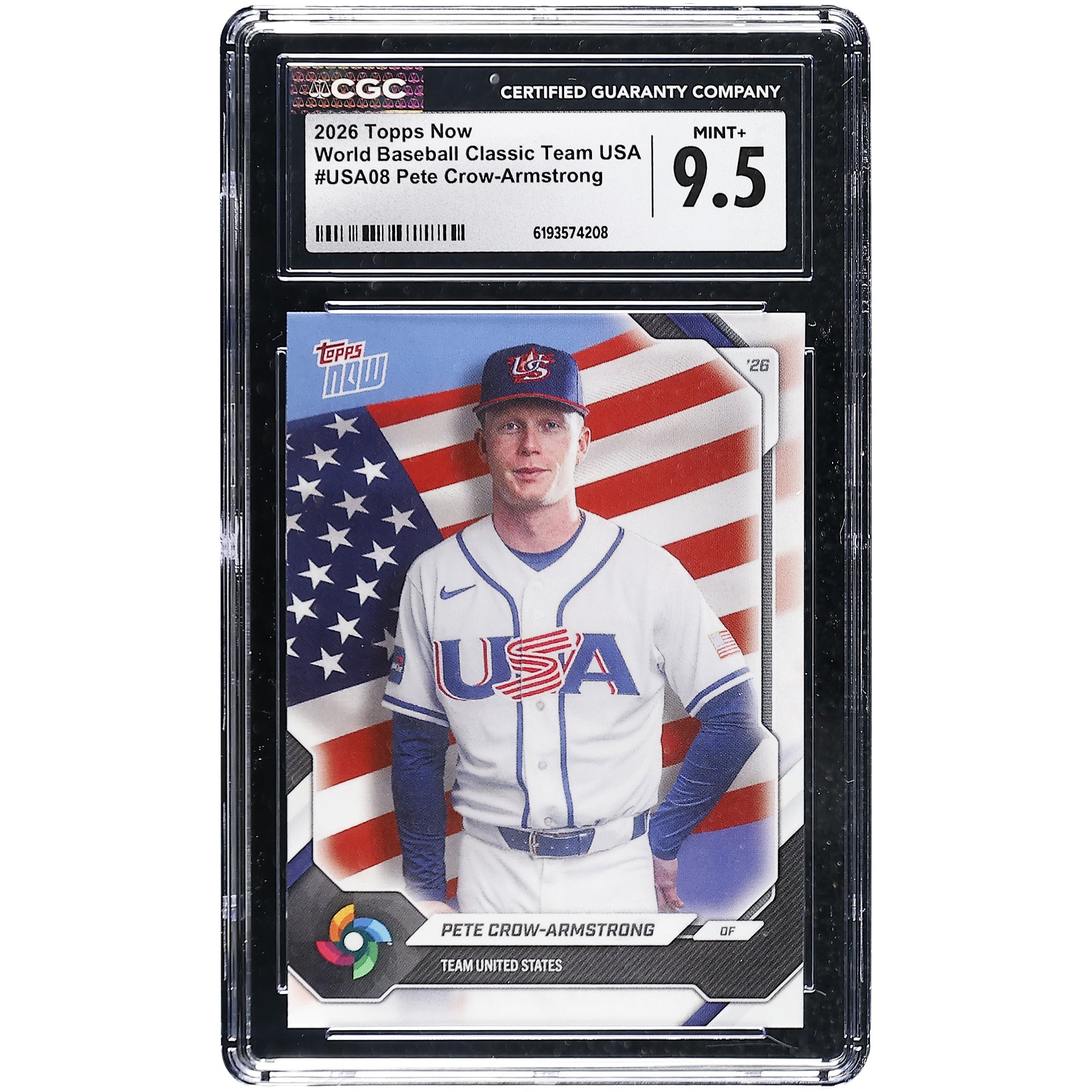 Topps NOW AD Pete Crow-Armstrong USA Baseball 2026 Topps Now #USA08 CGC Authenticated 9.5 Card See it at the official MLB Shop →
 The Trade Before the Career
On July 30, 2021, at the trade deadline, the New York Mets sent a 19-year-old outfielder named Pete Crow-Armstrong to the Chicago Cubs as part of a deal for Javier Báez and Trevor Williams. Crow-Armstrong, born March 25, 2002, in Sherman Oaks, California, had been the Mets' first-round pick just a year earlier. He would not appear in a major-league game for either team for two more years. The trade is a small but revealing artifact of how American professional baseball treats young talent: a prospect can be packaged and reassigned to a different organization, different coaching staff, and different developmental philosophy years before anyone outside a scouting department has seen him play a single big-league inning.
Left-Handed, All the Way Through
Crow-Armstrong bats left and throws left, a combination that is relatively uncommon among center fielders, where throwing left-handed can complicate certain angles and relay plays. He stands six feet tall and is listed at 184 pounds — a build suited more to range and closing speed than raw power, and it is his coverage of ground in center field, rather than his bat, that has defined his professional identity so far. He made his major-league debut with the Cubs on September 11, 2023, wearing number 4, arriving in the majors as what teams typically describe internally as a defense-and-speed profile still refining its offensive tools.
American professional baseball has no equivalent to the loyalty-based development systems used elsewhere; a first-round pick can be dealt away for an established veteran before he has played a single major-league game, and both the trading and acquiring fanbases will judge the deal — sometimes for years — based on what that prospect eventually becomes.
The Glove Arrives First
By his second full major-league season, Crow-Armstrong had won a National League Gold Glove Award for his play in center field — an official recognition from Rawlings and MLB, not a subjective media label, and a rare outcome for a player still so early in his career. Gold Gloves are voted on by managers and coaches (with a sabermetric component factored in), which means the honor reflects how the people who watch him most closely, not just statisticians or fans, assess his defensive instincts: reading swings off the bat, taking efficient routes, and closing on balls that a step slower a fielder would only reach in a dive. For a player whose path to the majors ran through being the return in a trade for an established veteran, arriving with the glove already ahead of the bat is its own kind of statement.
What Comes Next
Crow-Armstrong's story so far is really two stories layered on top of each other: the story of a trade, in which a prospect changed organizations before he had proven anything, and the story of a center fielder whose defensive value announced itself almost immediately once he reached the majors. The open question — the one that will define whatever comes next — is whether his bat will eventually catch up to his glove, or whether he becomes one of those players whose primary contribution to winning baseball games is never fully visible in a box score at all.
Official MLB Shop and Amazon links matched to Pete Crow-Armstrong and the Chicago Cubs.
Pete Crow-Armstrong Gear — Official MLB ShopThis profile was written by AI (Claude Sonnet) using publicly available sources. Interpretations and cultural notes are AI-generated and may not reflect the views of the player, their team, or MLB. This page contains affiliate links.