Michael Wacha
"Michael Wacha made the majors at 21, and a decade on he is still pitching, now for his sixth club."
Wacha debuted in the majors on May 30, 2013, at age 21, and within months was pitching in October for the Cardinals. A decade later he is on his sixth organization.
A starter who made the majors in his early twenties and is still holding a rotation spot in his mid-thirties is increasingly rare. Wacha anchors the Royals' rotation as a durable veteran at a time when many teams treat starting pitchers as short-lived assets.
His early fame as a postseason phenom can overshadow the more unusual part of his story: the second half of his career, built on adaptation and reliability rather than a single dazzling stretch.
Wacha has pitched for six major-league organizations: the Cardinals, Mets, Rays, Red Sox, Padres and Royals. Japanese fans, used to a pitcher's identity being tied to one franchise for years, may find this surprising. In MLB it is a normal career shape for a dependable starter, who signs where the opportunity and the contract are best. It says little about whether he was valued. Also, he was born in Iowa City, a college town in a state that Americans associate with farmland and baseball nostalgia. This is context about the place, not a claim about his upbringing.
American fans tend to read a long-serving, well-traveled starter as an innings-eater, a label that can sound like faint praise. Seen from the Japanese game, where rotation spots and one-team loyalty carry a different prestige, a pitcher who keeps earning a place in rotation after rotation looks closer to a craftsman. That reading is cultural context, not something Wacha has said.
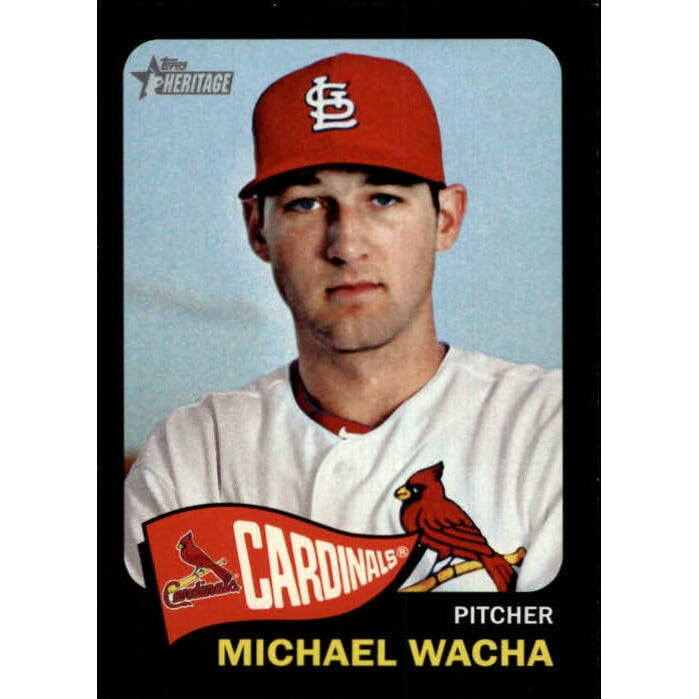
Michael Wacha, born in Iowa City, Iowa, is a 6-foot-6 right-handed starting pitcher for the Kansas City Royals. He reached the majors in May 2013, at 21, with the St. Louis Cardinals, and became one of that October's breakout names. His career since has run through several organizations, which makes him a useful example of the modern veteran starter. This profile is deliberately short because no interviews or primary sources were available.
| Year | Team | G | W–L | ERA | IP | SO | WHIP |
|---|---|---|---|---|---|---|---|
| 2026 | KCR | 32 | 9–10 | 3.32 | 200.2 | 158 | 1.11 |
| 2025 | KCR | 31 | 10–13 | 3.86 | 172.2 | 126 | 1.22 |
| 2024 | KCR | 29 | 13–8 | 3.35 | 166.2 | 145 | 1.19 |
| Career | — | 341 | 120–85 | 3.83 | 1828.0 | 1574 | 1.26 |
Source: MLB Stats API · regular season
A Very Early Arrival
Michael Wacha was born on July 1, 1991, in Iowa City, Iowa. He made his major-league debut on May 30, 2013, at 21, which is young for a pitcher at that level. He was widely reported to have been drafted by St. Louis out of Texas A&M in 2012, so the gap between college mound and big-league mound was only a matter of months. Few starters make that jump so quickly.
October 2013
Wacha's name became widely known that fall. By the public record, he pitched a game in late September 2013 in which he carried a no-hit bid into the ninth inning before it was broken up. He was later named Most Valuable Player of the National League Championship Series as the Cardinals reached the World Series. It was an early, outsized stage for a pitcher in his first full year, and it set expectations that few careers could meet.
In American usage, "journeyman" describes a player who moves between teams, often as a free agent, and it can sound faintly dismissive. For starting pitchers it also marks something worth noticing: a steady supply of teams that keep wanting him. It is a label about career structure, not necessarily about ability.
The Long Middle
Wacha has long been identified with his changeup, the pitch that gets hitters to swing early and miss. At 6 feet 6 inches and 215 pounds, he throws from a tall frame, a combination that has drawn attention since his college days. After his St. Louis years, his career moved through several organizations. The documented path is the Mets, Rays, Red Sox, Padres and now the Royals. That route reflects the ordinary economics of the game as much as any one performance. Veteran starters are signed, relied on, and signed again.
What the Record Cannot Tell Us
Nothing in the verified material available for this profile speaks to Wacha's habits, family or temperament, and we have chosen not to guess. We do not have an interview to quote, and a profile of a person should not be assembled from inference. What can be said is limited to the career: a young arrival, a defining October, and a long stretch of steady work that rarely makes headlines but fills a rotation. Readers who want the person rather than the pitcher should look for his own words in postgame interviews and long-form features.
Looking Ahead
Wacha now pitches for a Kansas City club that depends on durable starters. The question for the rest of his career is less about whether he can recapture 2013 than how long a pitcher who debuted at 21 can keep adjusting, and what a decade-plus of that adjustment says about him.
The NLCS MVP award is given for a short series, not a full season, and American fans often treat it as proof of nerve under pressure. We avoid that shorthand here. It is better read as evidence of how quickly a young pitcher can reach the sport's largest stage, and of how hard it is to maintain that attention afterward.
MLB Shop links matched to Michael Wacha and the Kansas City Royals.
Michael Wacha Gear — Official MLB ShopThis profile was written by AI (Claude Sonnet) using publicly available sources. Interpretations and cultural notes are AI-generated and may not reflect the views of the player, their team, or MLB. This page contains affiliate links.