Jurickson Profar
"A can't-miss prospect who had to reinvent himself twice just to stay in the major leagues."
Profar reached the major leagues at nineteen years old — before many of his American-born peers had finished college — and then spent the next decade rebuilding a career that early hype had already declared finished.
At an age when most former 'next big thing' prospects have long since washed out of the league, Profar remains a productive everyday outfielder in a pennant race — proof that a career derailed at twenty can still be salvaged at thirty.
The standard narrative treats Profar as a cautionary tale about prospect hype gone wrong, but that framing skips over how many position changes and organizational moves it actually took him just to remain in the majors at all.
Profar grew up on Curaçao, a Dutch Caribbean island of roughly 150,000 people whose Little League teams beat squads from the United States to win back-to-back Little League World Series titles in 2004 and 2005 — a small nation's baseball obsession that has produced a remarkable number of major leaguers relative to its size.
Profar's Atlanta teammate Ozzie Albies is also from Curaçao — meaning two regulars in the same Braves lineup grew up on the same small Caribbean island, part of a baseball pipeline that has also produced Andruw Jones and Kenley Jansen and that most American fans have never heard mentioned on a broadcast.
Jurickson Profar left Curaçao as a teenager and reached the majors at nineteen, arriving in September 2012 as one of baseball's most celebrated young talents. Injuries and shifting roles rerouted the career that scouts once projected for stardom. At thirty-three, the switch-hitting Curaçaoan now plays left field for the Atlanta Braves — a long, unglamorous route back to relevance that box scores alone don't explain.
| Year | Team | G | AVG | HR | RBI | SB | OPS |
|---|---|---|---|---|---|---|---|
| 2025 | ATL | 80 | .245 | 14 | 43 | 9 | .787 |
| 2024 | SDP | 158 | .280 | 24 | 85 | 10 | .839 |
| 2023 | — | 125 | .242 | 9 | 46 | 1 | .689 |
| Career | — | 1199 | .245 | 125 | 487 | 66 | .731 |
Source: MLB Stats API · regular season
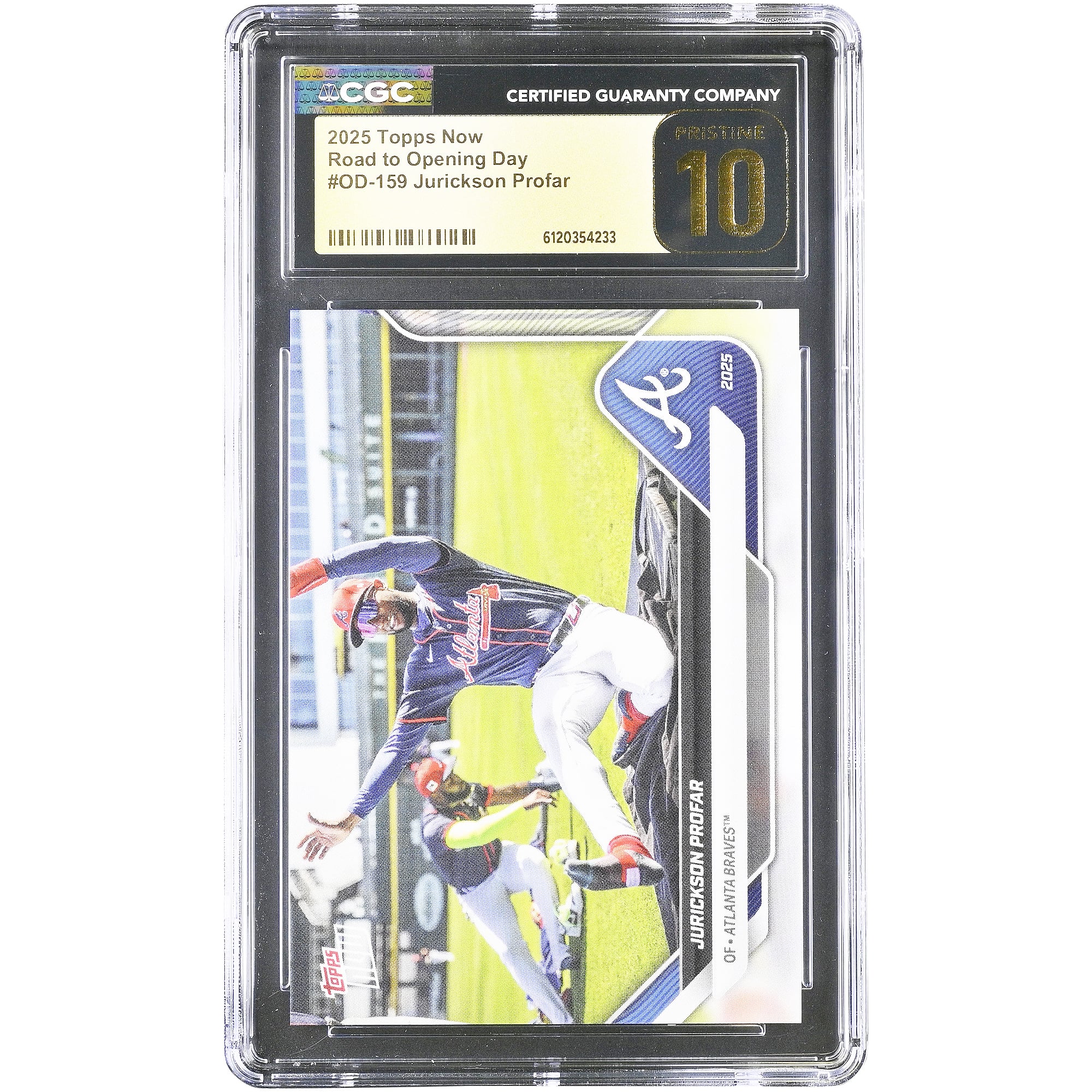 Topps NOW AD Jurickson Profar Atlanta Braves 2025 Topps Now Road to Opening Day #OD-159 CGC Authenticated PRISTINE 10 Card See it at the official MLB Shop →
 Nineteen and Already a Story
Jurickson Profar was born on February 20, 1993, in Willemstad, the capital of Curaçao, and reached the major leagues on September 2, 2012 — nineteen years and roughly six months later. That timeline alone tells you something: he arrived in a big-league clubhouse before most American ballplayers his age had finished a college season. A switch-hitter who threw right-handed, listed at five-foot-eleven and 184 pounds, Profar was not built like a power prospect. What made him remarkable was versatility — the ability to play shortstop, second base, third base, and the outfield at a level that made scouts talk about him the way they talk about players who come along once a decade.
The Long Detour
The player who debuted in 2012 as one of the most hyped prospects in baseball did not become a star in the way that hype predicted. Shoulder problems in the mid-2010s cost him significant chunks of playing time during what should have been his developmental prime, and by the time he was healthy again, the roster spot he'd been promised no longer existed. What followed was a career defined less by a single breakout than by persistence: a string of moves between organizations, repeated position changes, and long stretches of proving, year after year, that he still belonged on a major-league roster.
American fans often lump all Latin American major leaguers into a single cultural category, but Curaçao's baseball tradition is distinct: shaped by Dutch colonial ties (the island is a constituent country of the Kingdom of the Netherlands), a strong Little League system, and a small, tight-knit baseball community where top prospects are often known to each other from childhood. Profar and Braves teammate Ozzie Albies, both Curaçaoan, are part of that same small world.
An Island's Disproportionate Gift
Curaçao is a small island — about 170 square miles, a population smaller than many American mid-sized cities — but it has become one of the most productive sources of major-league talent per capita anywhere in the world. Andruw Jones, Kenley Jansen, and Profar's own Atlanta teammate Ozzie Albies all trace their roots to the island. Baseball there is woven into daily life partly through the island's ties to the Dutch Kingdom and partly through a Little League tradition strong enough to have twice beaten teams from the United States to win the Little League World Series championship, in 2004 and 2005. Profar came up through that same pipeline, signed as an amateur and shipped north to the U.S. minor-league system as a teenager, the way most of Curaçao's major leaguers have.
A Quieter Kind of Arrival
Now with the Atlanta Braves, wearing number 17 and playing left field, Profar occupies a role that looks nothing like the one that was mapped out for him in 2012 — and that may be the more instructive story. Baseball's traditional prospect narrative runs in one direction: phenom to All-Star, or phenom to bust. Profar's career runs sideways instead, through six-plus organizations and multiple defensive positions, arriving at relevance not as a finished product at twenty-three but as a still-working one past thirty. It is a less cinematic story than the one scouts originally wrote for him, but it is arguably a more honest picture of what a long major-league career actually requires.
Official MLB Shop and Amazon links matched to Jurickson Profar and the Atlanta Braves.
Jurickson Profar Gear — Official MLB ShopThis profile was written by AI (Claude Sonnet) using publicly available sources. Interpretations and cultural notes are AI-generated and may not reflect the views of the player, their team, or MLB. This page contains affiliate links.