Fernando Tatis Jr.
"Born in the Dominican Republic's most storied baseball city, Fernando Tatis Jr. arrived in the major leagues carrying a famous name — and spent the years since making it entirely his own."
Tatis Jr. was born on January 2, 1999 — the same year his father set an MLB record that has stood for 27 years: two grand slams in a single inning, off the same pitcher, in the same at-bat sequence. Father and son are permanently linked in the record books, separated by a single season.
After missing all of 2022 to injury and suspension, Tatis returned in 2023, won a Platinum Glove at an entirely new position, and earned All-Star selections in both 2024 and 2025. His comeback is no longer a question — it is a fully realized career chapter.
Tatis is often discussed as a product of talent and money. What gets less attention is where he comes from: San Pedro de Macorís, a provincial city on the southeastern coast of the Dominican Republic that has produced a disproportionate share of the world's professional shortstops — and what that environment, not the contract, forged in him first.
In San Pedro de Macorís, boys are scouted at age twelve. Signing with an MLB organization at fifteen or sixteen is not exceptional — it is the expected trajectory for players with ability. The city of roughly 250,000 people has produced more major leaguers per capita than any other city on earth. Tatis Jr. did not come from a baseball family by coincidence; he came from a city where professional baseball is a multigenerational neighborhood institution, and his father was already proof of concept. The contract and the spotlight came later. The formation happened in a very specific place.
When American fans hear Tatis Jr. called 'El Niño' — the boy — they may read it as a straightforward nickname for a young player. In Dominican Spanish, the term functions differently: calling a grown man 'the boy' is an expression of community ownership and affection, not diminution. It means, roughly, 'you are still ours; we knew you before all this.' The nickname did not come from a broadcaster or a marketing team. It came from San Pedro, and it travels with him.
Fernando Tatis Jr. was born January 2, 1999, in San Pedro de Macorís, Dominican Republic — a city that has sent more players to Major League Baseball than most entire nations. The son of former MLB infielder Fernando Tatís Sr., he debuted with the San Diego Padres at nineteen and within two seasons had signed the largest contract in franchise history. His arc since — suspension, reinvention, and sustained All-Star return — is one of the more complicated and compelling stories in the sport.
| Year | Team | G | AVG | HR | RBI | SB | OPS |
|---|---|---|---|---|---|---|---|
| 2026 | SDP | 144 | .284 | 20 | 72 | 32 | .800 |
| 2025 | SDP | 155 | .268 | 25 | 71 | 32 | .814 |
| 2024 | SDP | 102 | .276 | 21 | 49 | 11 | .832 |
| Career | — | 815 | .278 | 172 | 465 | 156 | .856 |
Source: MLB Stats API · regular season
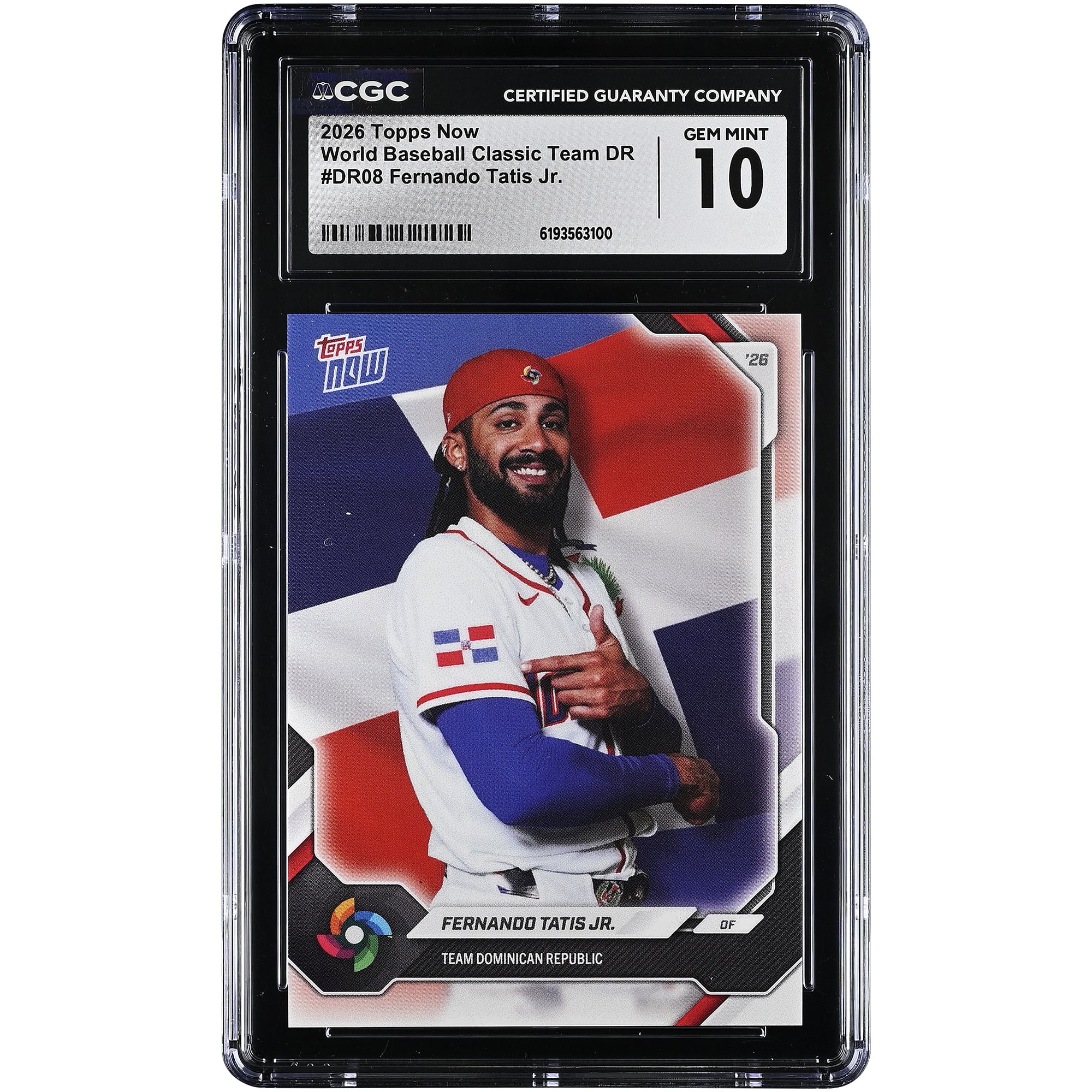 Topps NOW AD Fernando Tatis Jr. Dominican Republic Baseball 2026 Topps Now #DR08 CGC Authenticated 10 Card See it at the official MLB Shop →
 A City That Breeds Shortstops
Fernando Tatis Jr. was born in San Pedro de Macorís, a port city on the southeastern coast of the Dominican Republic, on January 2, 1999. The city's contribution to professional baseball is, by any measure, extraordinary — a small urban center that has produced dozens of major leaguers across multiple generations, earning it an informal reputation among scouts and historians as a singular incubator of infield talent. Tatis Jr. grew up inside this tradition, not observing it from the outside. His father, Fernando Tatís Sr., played eleven seasons in the major leagues as an infielder, most famously for the St. Louis Cardinals. The family's connection to the game is not incidental; it is structural — woven into the city, the surname, and the position the son would eventually make famous before moving on from it.
The Record That Came Before Him
On April 23, 1999 — roughly three and a half months after Tatis Jr.'s birth — Fernando Tatís Sr. stepped to the plate twice in a single inning at Dodger Stadium and hit a grand slam each time, off the same pitcher, Chan Ho Park. No player in major league history has hit two grand slams in one inning. The record has stood for more than a quarter century. For Tatis Jr., this legacy preceded his own career: he arrived in the major leagues already the son of a record-holder, already carrying a name that meant something before he could demonstrate what he intended to make it mean. Whether that weight shaped him is not something he has addressed at length in public sources. That it existed is simply a fact of his biography.
American fans sometimes encounter the phrase 'San Pedro de Macorís' as a baseball shorthand — a place known for producing players — without fully reckoning with what that means. The city is not a training academy or a regional talent center. It is a working-class Dominican city where baseball has been a dominant economic and cultural force for generations, where MLB academies have been present since the 1980s, and where the pipeline from local diamonds to professional rosters is well-worn and multigenerational. More major leaguers have emerged from this city, per capita, than from any other city on earth. When Tatis Jr. is described as coming from San Pedro, that sentence carries a full cultural history inside it — one that the box score, and most broadcast commentary, passes over in silence.
A Debut and a Deal
Tatis Jr. debuted with the San Diego Padres on March 28, 2019, nineteen years old and playing shortstop. His early seasons drew the kind of attention that alters a franchise's sense of its own future: his athleticism in the field and production at the plate were striking in combination. In 2020 he won the Silver Slugger Award at shortstop, and in 2021 he was named an All-Star and won a second Silver Slugger. Before the 2021 season began, the Padres signed him to a 14-year, $340 million contract extension — the largest in franchise history and, at the time of signing, among the largest in baseball history. He was twenty-one years old. The math of that transaction — the scale of commitment placed on a player with two full professional seasons behind him — was, by any prior standard, unusual.
Suspension, Silence, and a Position He Made His Own
Tatis Jr. did not play in 2022. He sustained a left wrist injury in the offseason, and before he could return, he received an 80-game suspension for testing positive for oxandrolone, a performance-enhancing substance. He acknowledged the violation. He returned in 2023 to a different role: the Padres moved him from shortstop to right field, a defensive repositioning that might have read as organizational consequence or as a managed decline. It read as neither. He won the Platinum Glove Award in right field that year — a peer-voted recognition of defensive excellence across all of baseball. By 2024 and again in 2025, he had returned to All-Star form. The suspension is a permanent part of his public record; so is everything that came after it.
What the Nickname Carries
He is known in the Dominican Republic and in baseball broadly as 'El Niño' — the boy, the kid — a nickname that attached early and has persisted well into his professional career. There is also 'Bebo,' a common Dominican diminutive without a clean English equivalent: a warmth marker, a term of closeness that tends to come from people who knew you first. In Dominican culture, nicknames are functional and affectionate, and they often tell you more about how a community perceives someone than any formal designation can. Both names were in use before he became famous. That detail is worth holding onto: the names came from somewhere, from people who knew him before the contract, before the All-Star games, before the record-book conversation about his father became a conversation about what his son would do next.
The 2022 suspension is a fixed part of Tatis Jr.'s public record, and it is regularly referenced in coverage of his career. In the Dominican Republic, oxandrolone — the substance for which he tested positive — is more widely available without prescription and less culturally coded as a sports-performance substance than it is in the United States. Tatis Jr. stated publicly that he had been taking medication for a ringworm infection. Whether American audiences find that explanation persuasive, it is worth knowing that the cultural and pharmacological context in the Dominican Republic differs meaningfully from domestic American norms, and that the violation reads differently in San Pedro than it does in a domestic American sports-media frame.
Official MLB Shop and Amazon links matched to Fernando Tatis Jr. and the San Diego Padres.
Fernando Tatis Jr. Gear — Official MLB ShopThis profile was written by AI (Claude Sonnet) using publicly available sources. Interpretations and cultural notes are AI-generated and may not reflect the views of the player, their team, or MLB. This page contains affiliate links.